
Trading and Import/Export in Big Ambitions 1.0
The dock is where the margin lives -- once the warehouse already works.
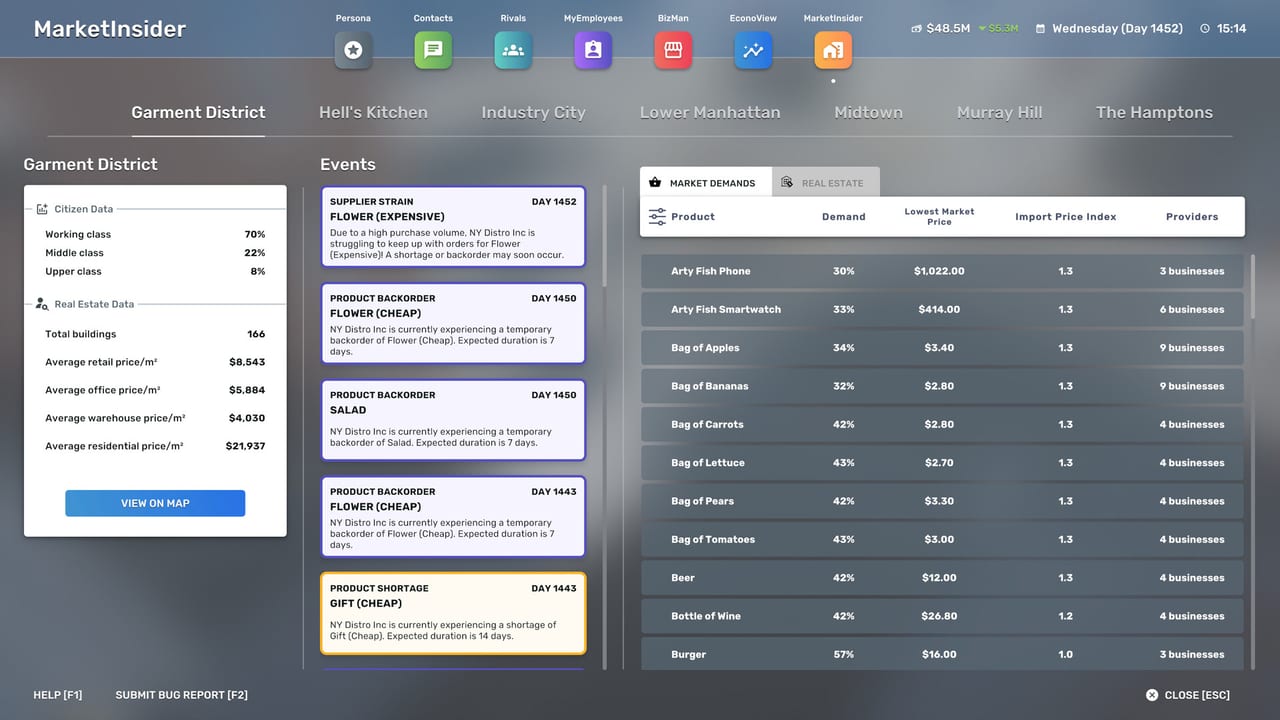
Trading in Big Ambitions 1.0 covers the import/export system: purchasing agents buying from dock suppliers, the product list available for trade, how dock contracts work, and the truck logistics that get goods from the harbor to your warehouse. This page is the trading operations guide next to importing for the contract mechanics and warehouses for the logistics chain.
Single-player: trading is entirely against NPC suppliers and NPC-led demand. There are no player-to-player trade mechanics.
What trading is in Big Ambitions
Trading means buying goods at a lower import price than your local wholesaler charges, then selling them through your own retail stores at the neighborhood markup. The gap between import cost and retail price is your margin. The gap between import cost and wholesaler cost is your competitive advantage.
The system works like this:
- You sign a dock contract with an import supplier.
- Your purchasing agent buys goods from that supplier’s catalog at import prices.
- The goods arrive at the dock and must be picked up by your truck.
- Your truck delivers them to your warehouse.
- Your warehouse distributes to your shops as normal.
The critical point: a truck has to physically carry goods from the dock to your warehouse. If you sign contracts but have no truck or no driver, the dock fills with uncollected pallets and you pay storage fees.
The import/export product list
Community guides and wiki sources document a product list organized by supplier and category. Key supplier groups:
Food and beverage suppliers provide perishable and shelf-stable goods that can feed supermarkets, convenience stores, and restaurants. Prices and weekly limits vary by supplier. Fresh produce has higher spoilage risk than dried goods.
Electronics suppliers offer components and finished consumer electronics. Smartwatches and accessories often appear in this category and can ride a jewelry or electronics floor in retail.
Clothing and textiles suppliers provide the raw materials for clothing stores. The classic modern and classic cheap matrix is the retail output; the supplier catalog is the input.
Industrial and manufacturing suppliers (Titan of Industry Supply and related vendors) provide the raw materials that feed production stations. See Industry City and factories for the production side of this trade.
Luxury goods suppliers serve the Hamptons retail strip and upper-class Midtown stores. These have higher unit prices but lower volume constraints.
The actual product list in your game client is the authoritative source. Community wikis are a starting shape, not a guaranteed price list.
How dock contracts work
A dock contract is an agreement with an import supplier to purchase goods at their listed import price. Contracts typically specify:
- Weekly delivery limits per product (resets Monday at 08:00).
- Volume discounts for larger orders.
- Urgent order options for mid-week restocking (at a premium price).
You do not pay upfront for a contract. You pay when your purchasing agent buys goods against the contract. The contract defines the ceiling (maximum weekly order) and the price.
Key behavior: weekly limits reset every Monday morning. If you hit your limit mid-week, you wait for the reset or pay urgent order premiums.
Trade routes and logistics
The dock-to-warehouse leg is the most commonly underestimated part of trading. A common beginner mistake:
- Sign a dock contract with a good import price.
- Assign a purchasing agent to buy against the contract.
- Never assign a truck to collect the goods.
- The dock fills with pallets. Storage fees accumulate. The contract looks bad.
The fix: every import supplier needs a truck route. The truck drives from your warehouse to the dock, loads, returns, and unloads. This happens on a schedule your logistics manager assigns. Without that manager and that truck, the chain breaks at step three.
See headquarters for how to staff the logistics manager. See warehouses for how the warehouse fits into the broader supply chain.
Profitable trading strategies
Start with one product family. Do not try to import everything at once. Pick the product family with the best margin gap between import and retail, prove the route works, then add a second.
Watch the weekly limit. Hitting the ceiling mid-week and waiting for Monday reset is a stockout. If you consistently hit the limit, renegotiate for a higher ceiling or split the product family across two suppliers.
Use urgent orders sparingly. They are useful for emergencies but the premium erodes margin. Build enough buffer stock in your warehouse that urgent orders are the exception, not the rule.
Match import quality to retail positioning. Cheap imports work in working-class neighborhoods. Luxury imports work in Midtown and Hamptons. Bringing Hamptons-tier goods to a Garment District store is a margin trap.
Track the actual margin, not just the price. A product with a low import price and a high retail price looks good on paper. If it has a large box size, high spoilage, or low turnover, the real margin per warehouse slot per day might be worse than a higher-price lower-margin alternative.
Common trading mistakes
- Signing contracts before a truck route exists.
- Ignoring weekly limits and running into stockouts mid-week.
- Importing products that do not match the neighborhood class mix.
- Overloading one truck with too many SKUs and creating delivery delays.
- Not checking actual in-game prices against community wiki data (prices can drift from community documentation).
For the contract signing flow, see importing. For the warehouse that receives the goods, see warehouses. For the HQ desk that manages purchasing agents, see headquarters. For the production side of trade (turning raw imports into finished goods), see factories.
Frequently Asked Questions
Quick answers to the most common questions.
How does trading work in Big Ambitions 1.0?
You sign dock contracts with import suppliers, your purchasing agent buys goods at import prices, and your truck delivers them to your warehouse for distribution to your stores.
What are the weekly delivery limits?
Each dock contract specifies maximum weekly orders per product, which reset every Monday at 08:00. You can use urgent orders mid-week at a premium price if you hit the limit.
Why are my dock pallets not being collected?
You need a truck assigned to the dock route and a logistics manager to schedule the pickups. Without those, pallets accumulate and you pay storage fees.
What products are most profitable to trade?
The best trade depends on your retail locations. Check Market Insider for neighborhood demand and compare import cost to retail markup. Luxury goods work in Midtown and Hamptons; volume goods work in Garment District.