
Industry City in Big Ambitions
Where New York makes things -- after you already make enough to need it.
Industry City opened in Early Access 0.9 and became the manufacturing heart of Big Ambitions 1.0. It sits east of the original map and houses the P1-P3 and Q1-Q3 lots designed for production, the Titans of Industry Supply vendor, Factory Supply Depot, Stonegood Architecture for factory furniture, IC Truckers for regional freight, and the US General Trucks dealership. If you need to make things rather than buy them, this is where it happens. This page is the Industry City orientation guide next to factories and warehouses.
Single-player: Industry City is not a district you visit on foot. You drive or get driven. The commute is part of the logistics cost.
Why Industry City exists in the game
The original Big Ambitions map lets you buy goods from wholesalers and import from dock contracts. Both work. Neither scales forever. When you have eight shops across three districts and a purchasing agent that cannot keep pallets moving fast enough, the question becomes: can I make the product cheaper than I buy it, and can I control quality by making it myself?
Industry City answers yes to both, but only for specific product families and only after the warehouse loop already works. The district is not a shortcut to profit. It is an optimization layer for players who have already optimized everything else.
What is in Industry City
P1-P3 lots are mid-sized industrial shells for production. P1 is the smallest, P3 the largest. Each has enough floor space for multiple production stations, input storage, output storage, and the factory workers to run them. P-lots are where most players start their first production line.
Q1-Q3 lots are larger heavy-industrial shells designed for complex multi-stage production. Q-lots have higher ceilings, more dock access, and floor plans that accommodate longer production chains. If a P-lot feels cramped for your jewelry line, the Q-lot is next door.
Titans of Industry Supply is the primary vendor for raw materials and production inputs. They are in Industry City for a reason: everything they sell feeds a station. When the factories guide talks about inputs, Titans is where you buy them.
Factory Supply Depot handles the distribution side: where your finished goods go after production. They are not a storage vendor — they are the outlet that lets a production chain feed directly into your distribution network without manual van runs.
Stonegood Architecture sells the industrial furniture that makes a factory function: workbenches, lockers, equipment racks, and the heavy-duty versions of home furniture that look wrong in a residential setting but right on a factory floor.
IC Truckers are the regional freight carrier based in Industry City. If you need dedicated truck coverage for production inputs or outputs within Industry City, they offer contracts. They are not a replacement for your primary van — they extend coverage into the manufacturing district.
US General Trucks at the Industry City lot is the truck dealership for heavier freight vehicles. The first van is fine for retail restocking. A second truck with a driver dedicated to Industry City routes is what separates a one-factory operation from a production complex.
How to get there
The bridge from the original map opened in 0.9. Players who started before that update had to wait for the narrative gate. In 1.0, the bridge is open from the start. Drive east from any Manhattan neighborhood or use the subway to the Industry City station if you prefer public transit for reconnaissance.
For a first factory visit, drive. You are hauling measurement tapes and blueprint ideas, not commuters.
What to do on your first visit
- Walk the P and Q lots. Get a sense of ceiling height, dock positions, and floor plan shape. A P3 that looks spacious on the wiki might feel cramped with your intended station array.
- Visit Titans of Industry Supply and check the raw material prices for whatever you plan to produce. Compare to your current buy price. The margin math is why you are here.
- Stop at Stonegood Architecture and bookmark the industrial furniture tab. You will need it before you sign any production lease.
- Drive back. Do not sign a lot on day one. Sleep on the commute and the margin math.
What not to do in Industry City
- Do not open a factory before a warehouse runs automatically. A factory with no inputs is a very expensive meditation room.
- Do not fill a Q3 on day one because it looks impressive. Start on a P1. Add stations when the first line is proven.
- Do not ignore IC Truckers if you are building multiple production lines. Dedicated freight coverage inside Industry City prevents the situation where your food line starves because your van is on a retail run.
- Do not confuse Industry City with a retail district. The foot traffic here is factory workers and truck drivers, not customers. If you want to sell to shoppers, go back to Midtown.
Industry City and the rest of the map
Industry City is not isolated. It connects to the broader logistics network through your warehouse and HQ. The typical flow:
- Purchasing agent buys raw materials from Titans of Industry Supply.
- Materials arrive at the Industry City lot via IC Truckers or your dedicated freight truck.
- Factory workers convert materials into finished goods at production stations.
- Finished goods move to Factory Supply Depot or directly to your primary warehouse via scheduled truck runs.
- Warehouse distributes to retail locations as normal.
HQ manages the purchasing agents and logistics managers who keep this chain moving. Without HQ, you are driving the van yourself to Titans every Monday. The headquarters page covers the desk work that makes Industry City production scalable.
When Industry City is worth it
Industry City makes sense when:
- You have two or more shops importing the same product family from a wholesaler.
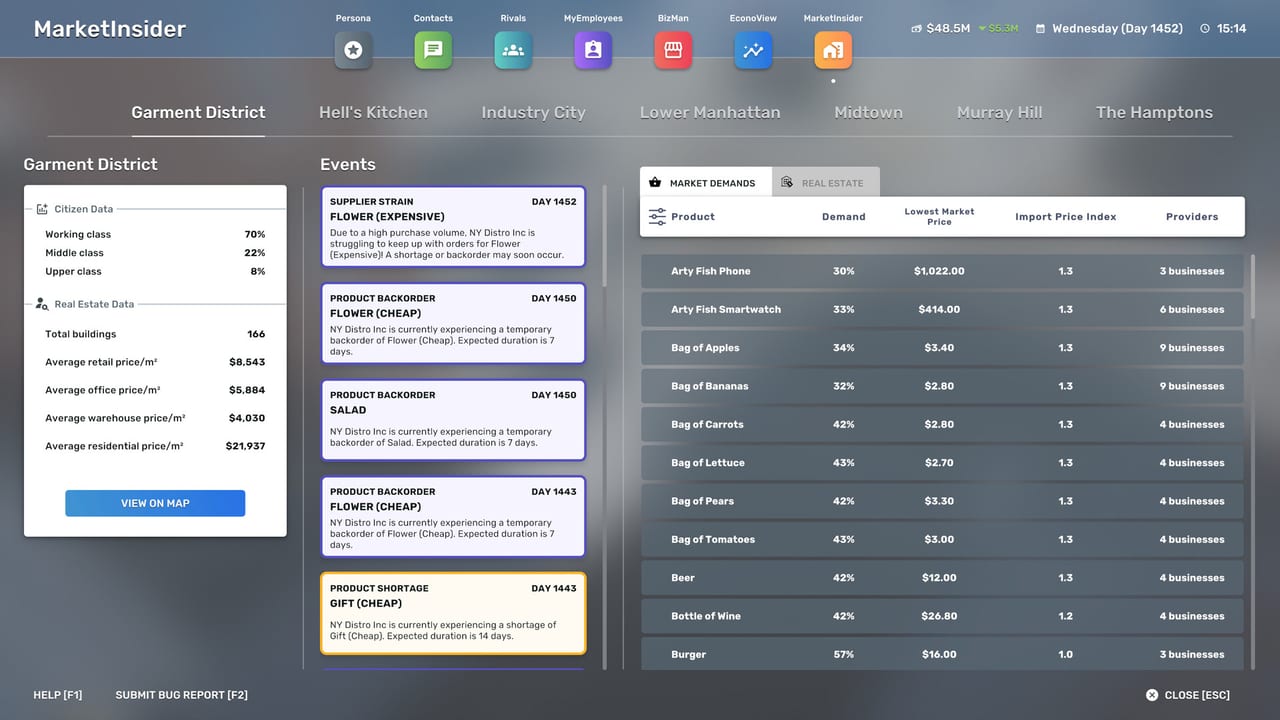
- Market Insider shows demand that your current supply cannot fill fast enough.
- You have a purchasing agent and logistics manager to staff the chain.
- You understand the production station output rates and the margin math.
Industry City does not make sense when:
- You are still learning the game. The tutorial covers retail, not manufacturing.
- Your warehouse does not run automatically yet.
- You have one shop and a dream.
- The product you want to make is already cheaper at the wholesaler than your production cost.
The factories guide has the station-by-station breakdown. This page is the district orientation. Read both before you sign a P-lot lease.
For the broader manufacturing picture — Industry City, production chains, feeding a C2 without overbuilding — the factories guide is the next read. For the logistics that get inputs in and outputs out, warehouses stays relevant even after you graduate to production.
Frequently Asked Questions
Quick answers to the most common questions.
Where is Industry City in Big Ambitions?
East of the original Manhattan map, accessible by driving across the bridge that opened in Early Access 0.9. It is in the full 1.0 release from day one.
What is the difference between P and Q lots in Industry City?
P-lots (P1-P3) are mid-sized production shells. Q-lots (Q1-Q3) are larger heavy-industrial spaces with higher ceilings and more dock access for complex multi-stage production.
Do I need a factory to use Industry City?
You need a production intention. P and Q lots are designed for production stations, but you can also use them as industrial warehouses with the right freight coverage.
What vendors are in Industry City?
Titans of Industry Supply (raw materials), Factory Supply Depot (distribution), Stonegood Architecture (industrial furniture), IC Truckers (regional freight), and US General Trucks (truck dealership).